- Friends You Wish You Had
- Posts
- Is Your Firm Invisible to AI?
Is Your Firm Invisible to AI?
Today's edition is all about Answer Engine Optimization - the art of getting seen, cited, and referred by AI. We'll talk about what AEO is, why it is going to be critical for your firm, and how it works. We'll close with some easy steps you can take to start improving your AEO today. Let's get to it 🎉

Adam Elend
June 25, 2025
Big Picture
What is Answer Engine Optimization
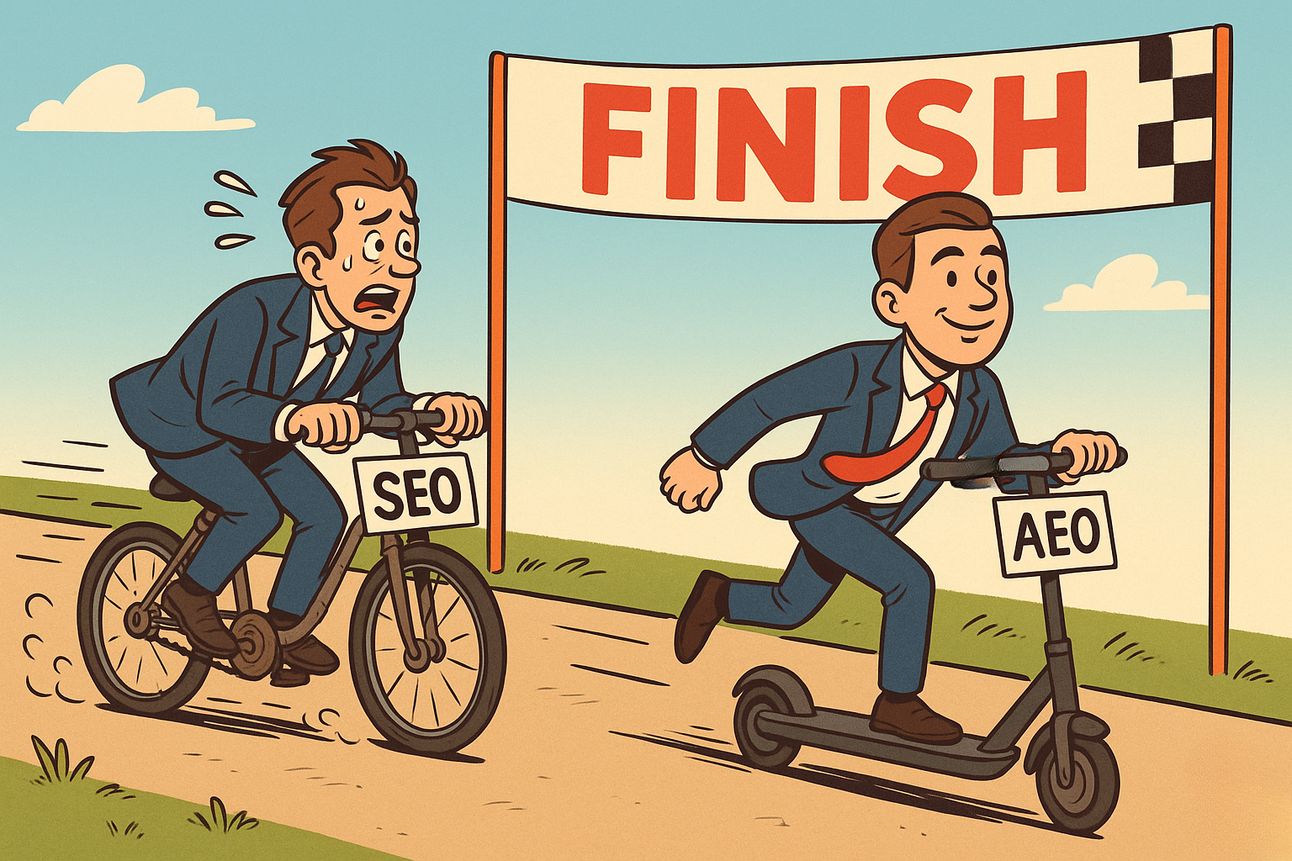
How do we find answers to questions on the web? Well, that’s changing as I write this. A business-owner used to type “Immigration Compliance lawyer” into google and follow the blue links. But now they're having full conversations with ChatGPT or Perplexity about I-9 audits.
Well, some of them are. But all the rest- they’re not following the blue links anymore. They’re reading the Gemini AI Overview first. These “answer engines” are giving back sourced information, quoting experts, and making explicit recommendations. If your marketing strategy is still focused on getting your website to rank higher, you're basically invisible in these conversations. And you can’t afford to be invisible.
Welcome to Answer Engine Optimization (AEO). It's not just the next evolution of SEO—it's a completely different playbook.
Example
Here’s what those answer engine conversations look like
When you see the kind of conversations folks are having with their answer engines, you begin to see how important it is to get into those conversations.
I recorded a ten minute video where I asked several different answer engines a simple question: “How do I protect my business from immigration raids.”
From that question, the answer engines:
cited specific law firms
quoted specific law firms
recommended specific firms and experts
Watch the video - you will not believe the amount of direct firm visibility that emerges from that simple question. Businesses and individuals are entering this exact type of query into ChatGPT or Google every day.
Context
AEO vs SEO
I like to think about it this way: your SEO strategy was built around influencing an algorithm. That algorithm is like a game with rules. You are trying to push the right set of buttons to achieve a desired result: a high ranking for your website that converts to you being in the first two pages of google results.
With AEO, you’re not trying to influence the LLM at all. And the goal isn’t to get your website cited. The goal to get your company cited and your value (research, insights, strategy, experience) quoted by AI. What you’re trying to do is make yourself irresistible to AI in order to attract it to your content.
Traditional SEO | AEO | |
|---|---|---|
Goal | Rank higher in search results | Get cited in AI-generated answers |
Target | Specific keywords | Natural language questions |
Where content lives | Your website | Everywhere AI looks |
Success metric | Search ranking position | AI citation frequency |
Strategy | Build backlinks, improve site speed | Create quotable, structured content |
“User” journey | Click through to your site | Get answer without clicking |
Strategy
So what can you do to AEO your website?
When Chat GPT searches the web, let’s review what happens:
GPT analyzes the query and “decides” what to search for. It could be one search or multiple, whatever it needs to return a complete response.
GPT sends its search queries to Bing, which brings back 10-20 results, the top ranked results for that search. Each result includes title and snippet (the meta description).
The AI crawls every result that it finds relevant, all at once.
It crawls results in the order that they respond to the call.
GPT synthesizes responses from the information at the links. It also quotes directly from some content, and cites sources (sometimes multiple for one piece of information).
Think about what would optimize your site to perform well in the searching behavior I’ve just described. First, you’re going to need to perform well on Bing in the initial searches. That means good SEO. Next, you need speed. Remember, the LLM is optimized to return a result as fast as possible. It’s a race between every relevant result to return results. Your site load speed is critical to getting into the race. Finally, it’s going to look for answers to the original query. As soon as it has what it needs, it moves on. SO to win the race, you need two things: relevant content and content that is highly structured so AI can find answers fast. Let’s put that all together:

Made with AI by Friends You Wish You Had
🔥 If you’d like to talk about Content or AI strategy for your law firm, the best first step is to reach out to me on LinkedIn (@adamelend) or schedule a free introductory strategy session here.
Distribution: think beyond your website
There is one more critical element to AEO as we understand it right now, and that’s distribution.
Really interesting data are starting to emerge around how LLMs source answers. Recent research from Profound analyzed 30 million AI citations over the past year to see where these answer engines pull information from. Here are the results:
ChatGPT's favorites:
Wikipedia dominates at 47.9% of citations
Reddit comes in second at around 11%
Then it's Forbes, G2, TechRadar, and other established sources
Google's AI loves:
Reddit (21% of top sources)
YouTube (19%)
Quora (14%)
LinkedIn (13%)
Perplexity goes heavy on community content:
Reddit makes up nearly half at 46.7%
YouTube at 14%
Even Yelp and TripAdvisor get cited
Earlier I described how Chat GPT searches the web, but the reality is that many queries are answered without the LLM needing to go to the web. Most answers can be found in its training data, or “memory”.
You can see the training reflected in the preferences of the different LLMs. For example, huge Reddit love from Perplexity… which is currently being sued by Reddit for training on its content.
But these sites are also a model of the four pillars of good AEO: great SEO, incredibly fast, relevant to answering questions, and highly structured (you can’t get more structured and sourced than wikipedia).
The lesson is clear…
If you want to improve your AI Visibility, your site is not enough. You need to distribute your relevant content in places like Youtube, LInkedIn, Reddit, Quora, and even Wikipedia.
The “Why”
Here’s why this matters for your firm
Gartner predicts that traditional search volume drops 25% by 2026, with most of that shifting to AI answer engines. Your potential clients are already asking these AIs for legal guidance. The only question is whose expertise those AIs will cite.
Part of the way I judge emerging trends is to look at changes in friction. Web video was around for years, but it exploded when Apple put video on the iPod in 2005 without charging a dime more for it - Apple reduced the friction and video took off.
There are plenty of friction indicators like that here, but the most obvious to me is the fact that every single google search now returns a Gemini AI overview. You and I both know that we’re going to end up reading that overview, whether or not we are looking for an AI answer. That’s a powerful signal about what’s ahead.
If you wait, you'll be in the same spot as firms that ignored SEO in the early 2000s: watching competitors dominate while you scramble to catch up.
The firms building AEO strategies now will be the trusted voices when someone asks an AI about complex legal matters. They'll be the expertise that gets quoted, cited, and remembered. 🦋
Explore
Want to learn more about AEO?
Here are some great links to get started:
A Marketer’s Playbook for AEO in 2025 (Profound)
AI Platform Citation Patterns (Profound)
The AEO Tactical Playbook (Shelly Palmer)
How Chat GPT Crawls the Web (Jerome Salamon)