- Friends You Wish You Had
- Posts
- In an AI world, your competitors are going silent. Here's how you get louder
In an AI world, your competitors are going silent. Here's how you get louder
Lawyers stand out in an AI world by consistently answering the questions their clients actually ask. Content is still king, and lawyers who focus on providing real answers become the trusted sources AI cites when clients need legal guidance. Let's get into it 🎉

Adam Elend
July 03, 2025
Big Picture
AI is already answering your clients’ questions
Your clients aren't choosing between you and AI. They're getting AI answers whether they want them or not.
Used to be that when a client had a legal problem, they googled it. Google would show them little blue links where they could go to find an answer. Search was like stopping to ask someone for directions.
Now, when someone stops to ask google "what happens if I get divorced?", it skips the directions and just straight up answers their questions. This is called an “AI overview.” Along with that answer, google’s going to share exactly where it found the information in the form of cites, links, and quotes.
Same thing with ChatGPT, Claude, and Gemini, where more and more people are going with questions. All of those AIs answer legal questions directly, and cite their sources.
The question isn't whether this is happening. The question is whether AI is citing you or your competitors when it answers.
Example
Here’s what those answers look like
Let’s take the example I used above. Here’s a screen shot of the AI overview that response generated. It’s important to note that this is tailored to my geographic location and my search history.
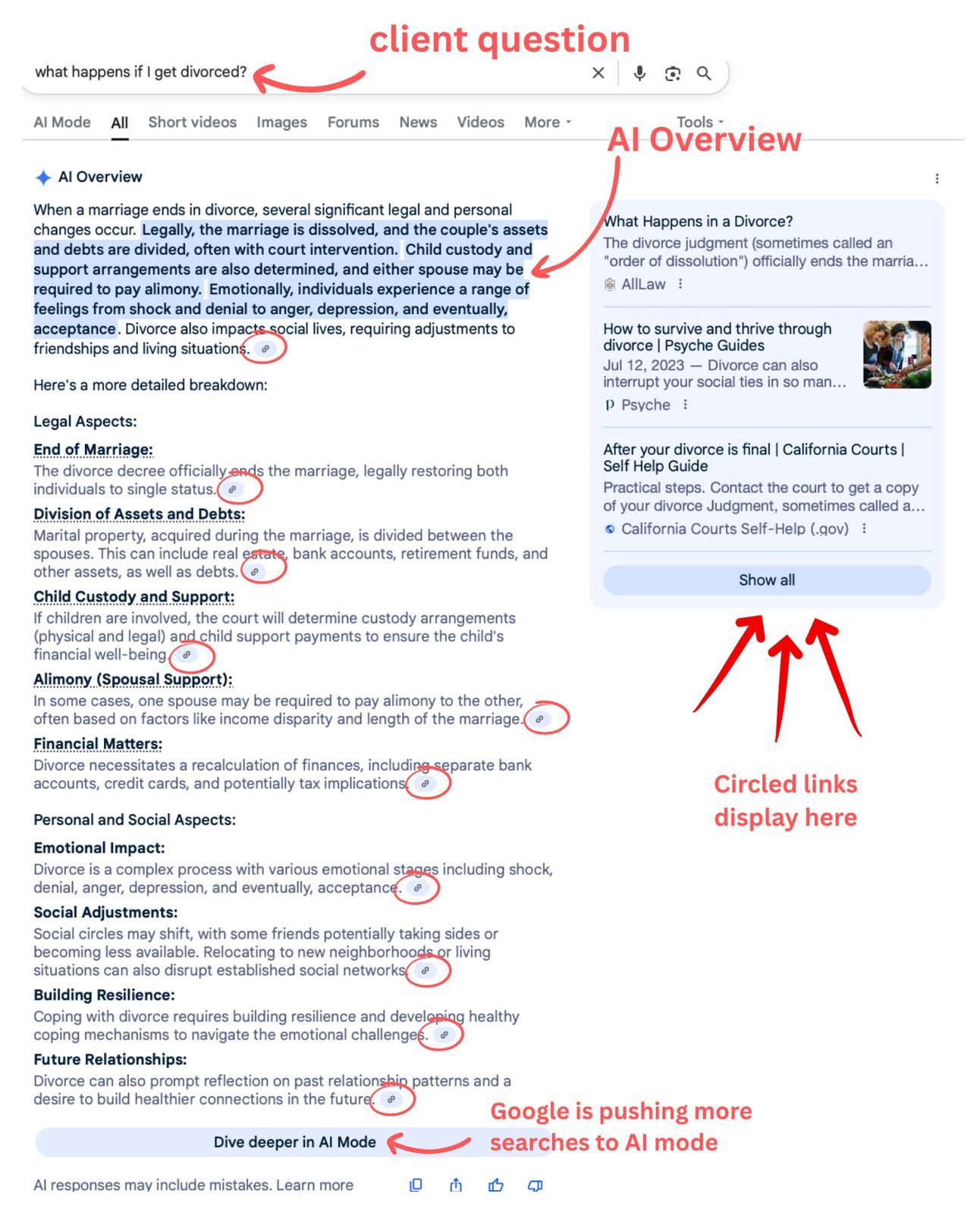
The AI overview gives a general answer to the question, cites specific law firms, and quotes specific law firms. This is what it means to be “in the AI conversation”
Context
Content equals answers now
I like to think about it this way: In an AI world, your reputation is built on how many relevant questions you answer in places AI can find them. Full stop.
The theory is this: you are a counselor. People turn to you for advice, sometimes in their hour of greatest need. Increasingly, people are getting advice from AI. But AI can’t deliver its own advice, it needs sources. It needs data.
When a client calls and asks a question, write it down. When you get the same question three times, test it. Ask that question in ChatGPT. Google it. See what comes back.
Are you cited? Are your competitors? Is the answer complete, or could you add something valuable?
If AI isn't finding your expertise, you don't exist in the new world. Lawyers who don’t accept this reality are starting to sound like the doctor who smirks when a patient comes into the office armed with WebMD research. There’s a seat waiting for both that doctor and that lawyer in the violin section on the deck of the Titanic.
Strategy
Start answering questions right now
You don't need a content team or a six-month strategy. You need to start answering questions.
If you're good on video, make videos. If you write well, publish articles. Post on LinkedIn. Answer questions on Reddit, Quora, even Wikipedia.
The format doesn't matter. The answers do.
Track Your Question Bank Every client intake call is content research. Every consultation reveals what people actually want to know. Start documenting:
What do they ask first?
What concepts confuse them?
What myths do you constantly correct?
Test Before You Answer Before spending time on content, take five minutes to do some research
Search your question in AI (Google, Chat GPT, Claude)
Check what sources get cited
Identify the gaps - what is the answer missing? What advice is meh?
Target those gaps to differentiate with your answer.
Make Your Content Accessible AI needs to find your answers to cite them. In a perfect world, you would build a content engine to help you find questions, write answers, and distribute your answers.
Don’t let the perfect be the enemy of the good. Just start answering on answer platforms like Reddit, Quora, and Wikipedia. If you have a blog, then publish your answers there. LinkedIn, Youtube, you name it. Where ever you can, just start publishing answers.
🔥 What’s your AI Influence Ranking? Are you crushing the competition or getting lost in the chat? For a limited time, Bright Red Pixels is giving away an exclusive report to show you exactly how you compare with your competitors in AI answers. Get it here free (at least until we sober up).
AI is exciting, but AI + data is game changing
AI craves reliable data. It makes sense if you think about it… I’m sure if you locked Faulkner in a dark room for his whole life, he’d still have produced some pretty amazing stuff. But when you pair Faulkner with data and let him learn what the world is like, you get The Sound and the Fury.
But data is valuable, and the more productive that AI gets, the more data sources will start gating and blocking AI bots from touching it. Yesterday, content delivery giant Cloudflare announced a new plan to default block all AI bots from the sites that use its service. We’re talking 27% of all sites on the web. The content pool is shrinking.
If you create content and you make it accessible, this is a huge opportunity for you. While your competitors worry about AI replacing lawyers, you can become the source AI relies on to answer your practice area's most important questions.
Next Steps
Start Today
You don't need permission from your marketing committee or budget approval from the managing partner.
Pick three questions clients asked you this week. Answer them. Post them somewhere AI can find them.
Your website, LinkedIn, a legal publication—anywhere accessible and authoritative.
The lawyers who start now will be the trusted sources when AI needs legal expertise. The lawyers who wait will watch AI cite their competitors instead.
Content is still king in an AI world. The difference is that content now means answers, not marketing messages.
Now go answer some questions 🦋
🔥 Ready to build AI Content Marketing for your firm? We help law firms create content engines that get cited by AI and generate real clients. Let’s talk about what that looks like for your practice.