- Friends You Wish You Had
- Posts
- How to Spot AI Legal Writing in the Wild
How to Spot AI Legal Writing in the Wild
AI writing follows predictable patterns: overuse of words like "delve," "robust," and "moreover," robotic sentence structures with dual adjectives, and formulaic transitions. Lawyers can spot AI content by looking for mechanical rhythm, overpolished language, and lack of genuine personality. This knowledge is powerful when dealing with opposing counsel, witnesses, or evidence. But a strategic attorney can also use this knowledge to make their own use of AI invisible. Let’s get to it😎

Adam Elend
July 10, 2025
Big Picture
The question isn’t whether lawyers are using AI…
it’s whether they're using it well enough that you can’t tell.
Your opposing counsel just filed a brief that sounds oddly perfect. Too many "moreovers" and "furthermores." The arguments flow like they came from a template. You start wondering: did they just copy-paste from ChatGPT?
With AI adoption in law firms jumping from 19% in 2023 to 79% in 2024, this scenario isn't hypothetical anymore. AI-generated legal content is everywhere, and at least 21 federal trial judges have issued standing orders regarding AI use.
Spotting AI writing is about gaining a competitive edge over your opposing counsel. If their writing is full of AI Voice, then they are using AI (and using it not very well). This is an important signal. You need to take a closer look at their work… are the citations real? Are the arguments coherent and properly weighted? Is there a chance that some evidence is AI produced? Are they disclosing their AI use and, if not, what else are they not disclosing?
Client Trust: If your motion reads like it came from a content mill, judges notice. According to a 2024 Stanford University study, large language models hallucinate at least 75% of the time when answering questions about a court's core ruling. When AI-generated briefs contain fabricated cases, it destroys credibility.
Professional Standards: As of 2025, there are 16 state bars that have addressed or are planning on addressing AI and legal ethics. Understanding AI patterns helps you comply with disclosure requirements and maintain quality standards.
Competitive Intelligence: Recognizing AI patterns in opposing counsel's work can reveal their research depth and preparation quality. Sometimes that "comprehensive" brief is actually surface-level AI generation.
Context
The AI Voice: Why Robots Write Like Robots
AI models predict the next word based on patterns in training data, making them inherently derivative and full of linguistic clichés. Frankly, we humans do this too. But the patterns and cliches we choose are unique to our own experience.
Our choices also reflect our cultural moment and the slow but steady evolution of the language. All those things make our “voice” unique.
If Chat GPT wrote something posted one time on your LinkedIn feed, there’s no way you could detect the patterns that define AI voice. But the quantity of AI created writing to which we are exposed makes those patterns painfully obvious.
Rather than gradual linguistic evolution, AI creates sudden spikes in specific word usage—almost like a step function with no real-world motivation.
What you get with AI voice is:
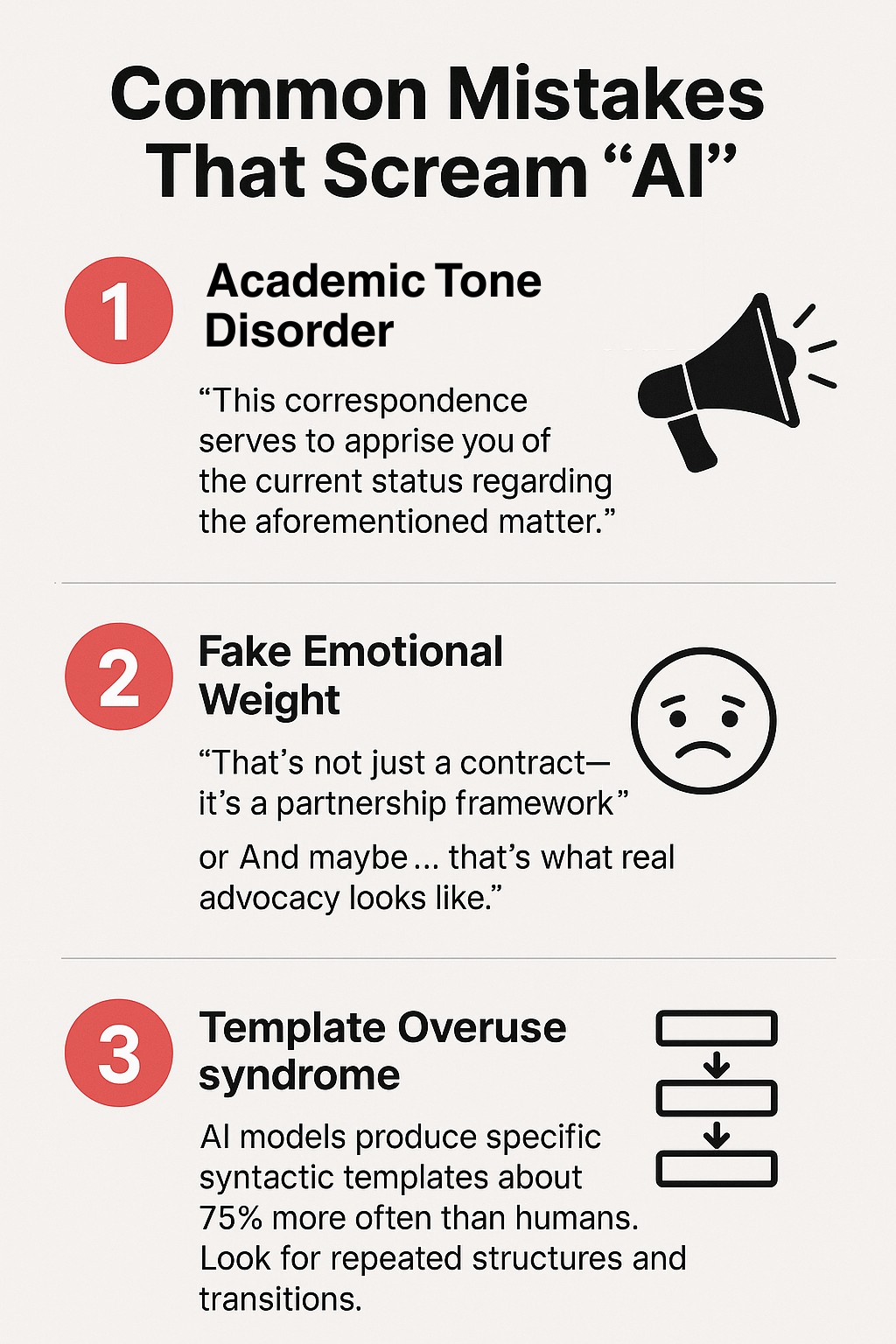
Pattern Dependency: AI models structure sentences in specific, repetitious ways more often than humans, with each model having its own "signature" syntactic patterns. It's like each AI has a preferred sentence template it can't break.
Cliché Concentration: Common AI words include "delve," "underscore," "pivotal," "harness," and "illuminate"—words that sound intelligent but lack substance. ChatGPT particularly overuses "delve into," creating abstracts filled with obvious AI tells.
Action
The Tell-Tale Signs: How to Spot AI-Speak in Legal Writing
Word Choice Red Flags
Key AI buzzwords include: meticulous, complexities, realm, robust, cutting-edge, harness, delve into, navigate, testament, and game changer. In legal writing, watch for:
Overuse of "moreover," "furthermore," "consequently"
Phrases like "it is crucial to understand" or "it is important to note"
"Let's unpack this" or "Here's what that really means"
Structural Patterns
The Rule of Three: AI loves three short phrases in succession: "We researched thoroughly. We analyzed carefully. We crafted precisely."
Dual Adjectives: AI frequently produces patterns like "unique and intense," "highly original and impressive," or "magical and thought-provoking" within short spans.
Formulaic Transitions: Scripted phrases like "Let that sink in" or "But what's the bigger picture here?" signal AI authorship.
Just a Feeling: The Uncanny Valley Effect
AI writing tends to follow predictable patterns—formal tone, repetitive phrasing, and structured transitions that lack personal nuance. Legal AI writing often sounds like:
Every argument has equal weight and similar phrasing
Transitions feel too smooth, like a well-oiled machine
Missing the personality quirks that make human writing memorable
Strategy
A Lawyer's Guide to Not Getting Caught Writing Like a Robot
The goal isn't to avoid AI—it's to use it so well that your writing sounds distinctly human. Here's how:
1. Give AI More Context
When I see writing that is obviously AI, the first thing I think is, “they didn’t give it anything to work with.” Most lawyers give AI terrible prompts like "write a motion to dismiss."
With no context about what it’s doing or why, that AI will simply go into its bag of tricks and whip out a motion filled with AI-speak. Even worse, giving the AI no structure at all makes it more likely to hallucinate.
I recorded this video with the exact process I use to write blog posts with Claude. I give it the right context and the right structure to get the output I’m looking for, and it’s been one of the most powerful automations in my business.
2. Be Transparent (Zag)
Don’t try to hide AI use. Disclose it.. Some firms now include footer disclaimers: "This document was drafted with AI assistance and reviewed by licensed attorneys." There’s no shame in using AI, only in using AI badly.
3. Ask AI for Input, Not Output
But really… should you even be trying to write with AI?
CEOs of companies worth hundreds of millions of dollars are using AI everyday, but they’re not having it write their emails. The best approach I've seen to writing with AI prompts it to challenge the writing, instead of doing the writing. Ask: "What's the weakest argument here?" "Where am I being unclear?" "What would opposing counsel attack?"
AI performs much better with handling input than it does generating output. Just think about phone calls - when you call the cable company and get an AI operator, you could care less. You need something from the cable company, and you just want it as quickly as possible.
But when an AI sales agent from the cable company calls to try and sell you something, you are incensed. AI works a lot better with input than output.
When you use AI to challenge your assumptions and poke holes in your argument, you are leveraging that input capability.
AI is great at pattern recognition. It can be really helpful in pointing out where your argument is presumptive or conclusory. But trust your own analysis of the law - it’s still a 1st year associate.
🔥 What’s your AI Influence Ranking? Are you crushing the competition or getting lost in the chat? For a limited time, Bright Red Pixels is giving away an exclusive report to show you exactly how you compare with your competitors in AI answers. Get it here free .
FAQ
Q: Are AI detection tools reliable for legal documents? A: Current AI detectors have accuracy rates around 92-95%, but they're not 100% foolproof and can produce false positives. They're better for general detection than definitive proof.
Q: Can I ethically use AI for brief writing? A: All nine ethics opinions issued so far discuss lawyers' supervisory duties related to generative AI use, treating AI like a paralegal requiring oversight. The key is proper supervision and disclosure when required.
Q: What if opposing counsel is using AI heavily? A: Focus on the quality of arguments rather than the source. Most lawyers report that AI produces work roughly equivalent to a first-year associate—competent but requiring experienced review.
Q: How do I improve my AI prompts for legal writing? A: Provide context, assign specific personas, set clear conditions, and use example patterns rather than vague instructions. The more specific your input, the more human your output.